
Lithos Overview
Lithos is a 3,3 DEX built on the Plasma blockchain. It is designed to serve as the central liquidity layer for Plasma, providing traders, liquidity providers, and governance participants with a sustainable platform that grows alongside the ecosystem.
Unlike traditional DEXs that rely heavily on short-term liquidity incentives, Lithos is structured around the ve(3,3) model, which prioritizes long-term alignment between all participants. This means:
- Traders gain access to deep liquidity and low-slippage swaps.
- Liquidity providers earn both trading fees and emissions, creating consistent yield opportunities.
- veLITH holders shape the direction of the protocol, deciding how liquidity incentives are distributed.
- New projects can bootstrap liquidity and community trust through the Foundry Launchpad.
Lithos functions as Plasma’s liquidity engine, integrating trading, governance, and ecosystem expansion into a unified system. Plasma mainnet contract addresses are listed in Developer Documentation → Deployed Contracts.
Official Links
Core Products
Lithos DEX
The DEX is the foundation of the platform. Built on ve(3,3) mechanics, it ensures liquidity is both deep and sustainable.
- Swaps with Minimal Slippage: Traders can exchange assets across stable and volatile pools with optimized routing that reduces price impact.
- Liquidity Provisioning: LPs deposit assets into pools and earn yield from both trading fees and veLITH-directed emissions.
- Transparent Analytics: All liquidity, fees, and rewards are trackable through the dashboard, giving participants clear insight into their positions.
- Governance Integration: Unlike traditional DEXs, emissions are not dictated by the core team but by veLITH holders, aligning liquidity flow with community incentives.
Foundry Launchpad
The Foundry Launchpad acts as the entry point for new projects building on Plasma. It lowers the barrier to entry by offering both technical and liquidity support.
- Liquidity Bootstrapping: Projects can instantly access the Lithos DEX to establish liquid trading pairs.
- Governance Whitelisting: Projects can seek gauge approval, allowing them to direct emissions toward their pools, creating deeper liquidity.
- Community Access: Foundry projects benefit from integration into Lithos governance and the Plasma ecosystem.
- Ecosystem Resources: APIs, SDKs, and direct support make it easier for teams to integrate without building infrastructure from scratch.
Protocol Design
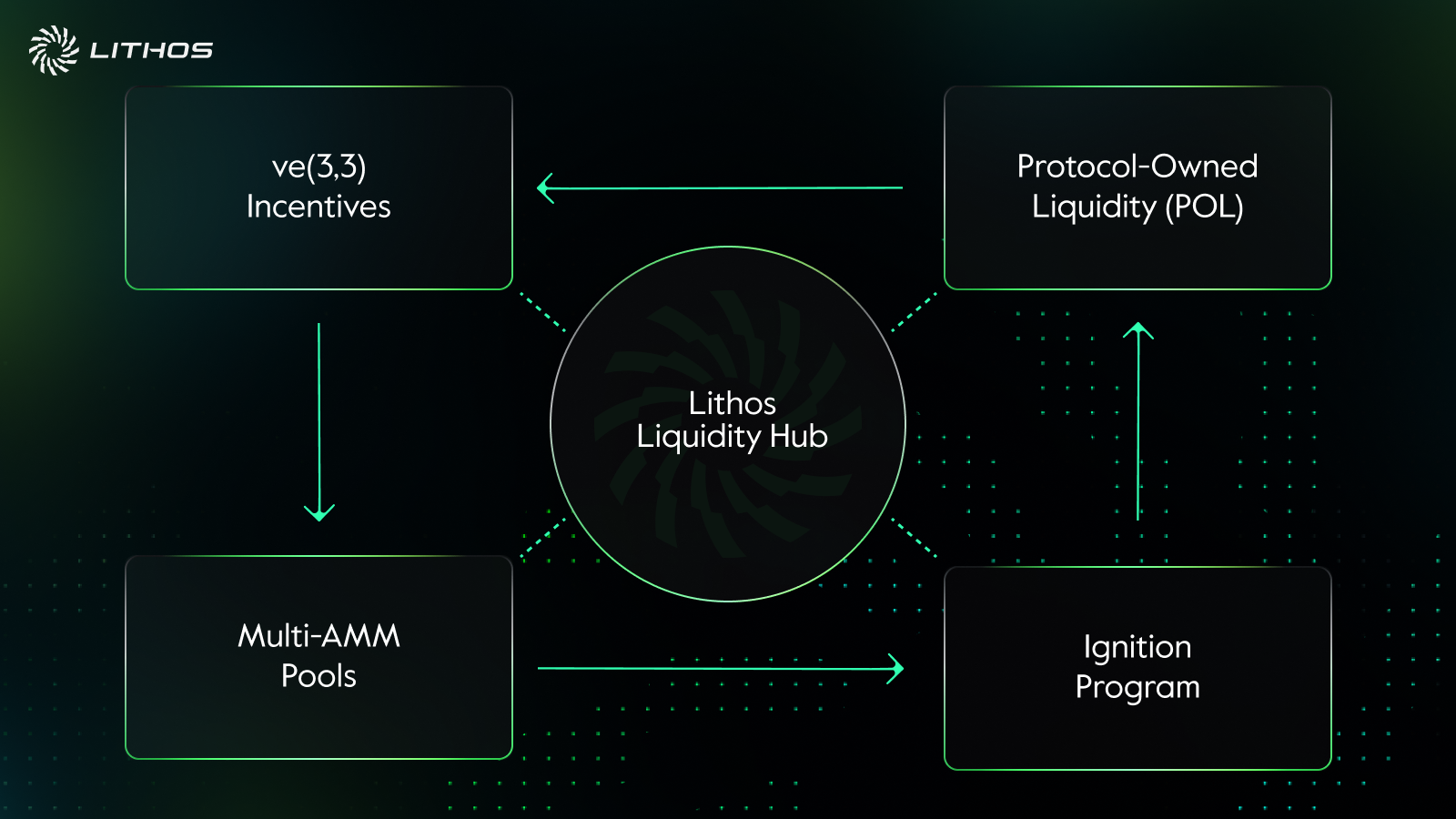
Lithos combines several mechanisms to build a liquidity system that can last through market cycles:
- ve(3,3) Incentives:
- Locking LITH generates veLITH, which represents voting power.
- veLITH holders control emissions, deciding which pools receive rewards each week.
- The system rewards long-term commitment through extended lock periods, giving participants more influence and higher returns.
- Emissions flow to where the community sees value, not where a central team dictates.
- Protocol-Owned Liquidity (POL):
- A share of revenue is reinvested to create permanent base liquidity.
- This reduces dependency on short-term LPs who might otherwise leave after rewards dry up.
- POL ensures there is always liquidity for core trading pairs, supporting price stability.
- Ignition Program:
- Revenue from trading fees and protocol positions is used to buy back LITH on the open market.
- These tokens are redistributed to veLITH holders, creating a feedback loop of rewards.
- Ignition not only incentivizes governance participation but also applies deflationary pressure on the token supply.
- Learn more about the Ignition Program cycle, tiers, and boosts.
- Multi-AMM Pools:
- Stable Pools: Optimized for correlated assets (e.g., USDC/USDT), offering minimal slippage.
- Volatile Pools: For uncorrelated assets, allowing price discovery while still generating fees.
- Concentrated Liquidity Pools: LPs can choose tighter ranges for higher efficiency, maximizing capital use.
- Multiple Fee Tiers: Pools can be configured with fees appropriate to their risk level, ensuring flexibility across asset classes.
Governance
Governance is the foundation of Lithos, giving token holders direct influence over how the protocol develops.
Locking Mechanism
Users lock LITH to mint veLITH. Longer lock durations grant greater voting power, discouraging short-term speculation while rewarding participants who commit to the protocol.
Gauge Voting
veLITH holders guide emissions through weekly gauge voting. By deciding which liquidity pools receive incentives, the community ensures that rewards remain aligned with real trading demand.
Reward System
Voters are rewarded not only with emissions but also with bribes from external partners and a share of protocol revenue. Diverse reward flows give participants stronger reasons to stay engaged in governance and liquidity provision.
Community-Led Decisions
Because veLITH holders control the flow of emissions, the ecosystem grows in the directions most valued by the community. This prevents centralized manipulation and distributes decision-making power across active stakeholders.
Plasma Advantages
Building on the Plasma blockchain gives Lithos a set of unique benefits that strengthen its role as a 3,3 DEX.
Gas-Free USDT Transfers
Plasma provides native support for USDT transfers without gas fees. Traders can move stablecoins at no extra cost, making swaps more efficient and cost-effective.
Stablecoin-Optimized Infrastructure
With more than $2B in stablecoin liquidity already active, Plasma is purpose-built for stablecoin-driven markets. This foundation makes it an ideal environment for deep, reliable liquidity pools.
High Performance
PlasmaBFT consensus delivers over 1,500 transactions per second. This capacity enables low-latency swaps and supports the trading volumes needed by both retail and professional users.
DeFi Integration
Lithos is directly connected to more than 100 ecosystem partners, including Aave, Ethena, and Fluid. This level of integration expands utility and ensures immediate interoperability with the wider DeFi landscape.
Security Anchored to Bitcoin
Plasma’s security model anchors to Bitcoin, providing resilience against network attacks. Backing from Tether, Bitfinex, and Framework Ventures further reinforces confidence in the chain’s long-term reliability.
Revenue Model
The revenue framework of Lithos is built for sustainability and long-term value capture. Each stream reinforces liquidity depth, governance participation, and token demand.
Trading Fees
- Every swap executed on the DEX generates a fee.
- Fees are shared between liquidity providers, veLITH holders, and the protocol treasury.
- As trading activity grows, participants benefit from higher and more consistent rewards.
veNFT Holdings
- The foundation maintains long-term veLITH locks to remain an active stakeholder.
- veNFT positions allow the foundation to earn protocol rewards without controlling emissions directly.
- This structure aligns the foundation with community incentives while avoiding centralization.
Ignition Program
- A share of protocol revenue funds the Ignition Program.
- Revenue is used to purchase LITH from the open market, reducing circulating supply.
- Bought-back tokens are redistributed to veLITH holders, rewarding governance participants and driving sustained demand for LITH.